
 JILIVIP
 Bingo
Bingo Casino
 Fishing
 Sabong
 Slot Games
 Sports
 Promotion
 Lottery
 News
News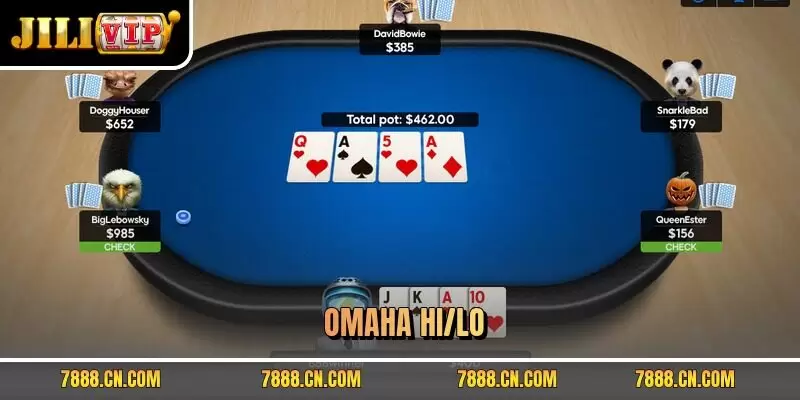
Omaha Hi/Lo is a highly strategic poker variant on JILIVIP that rewards players who think in multiple directions. Every hand offers the chance to compete for both high and low outcomes, creating deeper decisions from start to finish. With a balanced structure and quick action, the game keeps tension high and strategy constant in every round.
Interesting facts that define Omaha Hi/Lo gameplay

Interesting facts that define omaha hi/lo gameplay
Omaha Hi/Lo builds on classic Omaha poker by splitting the pot between the best high and low hands, adding depth and strategy to every round. A player can win the full pot if they hold both qualifying hands, making hand selection and timing even more critical during play.
To qualify for the low pot, players need five unpaired cards ranked eight or lower, with Aces counted as low. If no low hand qualifies, the high hand takes everything. On JILIVIP, Omaha Hi/Lo games are fast and fair, with smooth access across devices via browser or the official app.
Understanding the core rules of Omaha Hi/Lo poker

Understanding the core rules of omaha hi/lo poker
Grasping the mechanics of Omaha Hi/Lo is essential for new players and valuable for experienced ones refining their technique. This section explains how betting rounds work, how pots are split, and which hands have the strongest potential.
Hole cards and community structure
Every player in Omaha Hi/Lo receives four private hole cards. These cards are unique to each player and are not visible to opponents.
Five community cards are dealt face up in the center of the table across three rounds: The flop (three cards), the turn (one card), and the river (one card). To assemble their superior five-card combination, participants are required to utilize precisely two cards from their private holdings along with three cards from the shared deck.
Split pot mechanics
At showdown, the pot is divided between the highest ranked traditional poker hand and the lowest qualifying hand. If no player has a low hand, the entire pot goes to the high hand. Players can win one half, or in rare cases, scoop the entire pot by holding the best high and low hands. The strategic challenge lies in building hands that can compete on both sides.
Here’s a breakdown of pot scenarios:
| Scenario | Pot distribution |
| High hand only qualifies | Entire pot to high winner |
| High and low hands split | Pot divided 50/50 |
| One player wins both | Entire pot to one player |
Betting rounds and structure
It follows a similar betting structure to Texas Hold’em, with four distinct betting rounds:
- Pre-flop: Players bet after receiving hole cards
- Flop: The initial three community cards are shown
- Turn: Fourth community card is revealed
- River: Fifth community card is revealed
Players can raise, call, fold, or check depending on their position and the action before them. On JILIVIP, betting ranges vary by table and include both fixed limit and pot limit formats.
Qualifying low hands
To win the low half of the pot, a player must make a five card hand with each card ranked eight or lower. No pairs or repeats are allowed. Aces are low, and straights or flushes do not disqualify the low hand.
Example of a strong low hand: A-2-3-4-6
This would beat a low hand like A-2-3-5-8 due to the six being lower than the eight.
Understanding these rules is the foundation for applying advanced strategy and developing consistent success at Omaha Hi/Lo tables on JILIVIP.
Stop guessing and let Omaha Hi/Lo reveal pro secrets

Stop guessing and let Omaha Hi/Lo reveal pro secrets
Omaha Hi/Lo rewards players who think ahead, observe carefully, and adapt quickly. With two sides of the pot in play, being one dimensional is not enough. Below are five strategic perspectives that can dramatically improve your results at the tables.
Play starting hands with strong scoop potential
The best hands are those that can compete for both the high and low pots. Hands with A-2 suited or A-3 combinations offer flexibility and the chance to scoop.
Avoid hands that are only strong on one end unless the table dynamic justifies it. Double suited hands or those with connected low cards increase your ability to hit both sides of the board effectively.
Be cautious with marginal low hands
A low hand that qualifies does not always mean it’s good enough to win. Hands like 7-6-5-3-2 can qualify but are vulnerable to stronger lows.
Chasing a weak low can leave you splitting a pot you could have folded away from. Focus on building lows with A-2 or A-3 combinations to keep control of the betting and avoid getting trapped by stronger opponents.
Observe how community cards impact both sides
The board often dictates which half of the pot is worth pursuing. If the flop includes high cards, it’s likely that a low hand will not be possible. In such cases, focus entirely on the high side.
Conversely, if the flop comes A-2-5, expect multiple players to compete for the low. Shifting your strategy based on the board is vital to staying efficient and making well timed bets.
Bet aggressively when you hold both high and low draws
Holding hands like A-2 with strong connected cards gives you equity on both the high and low sides. When you’re drawing toward the nut low and a strong high combo like a straight or flush, you gain a significant advantage over opponents holding one-way hands.
This dual potential lets you apply pressure and take control of the pot. The chance to scoop both halves forces weaker hands to fold and protects your overall equity, especially in multiway pots where maximizing value and minimizing risk is key.
Avoid overcommitting with high only hands on low boards
One of the biggest mistakes players make in the game is overvaluing high hands when the board clearly supports low hands.
For example, holding a high pair like K-K on a flop of 2-3-5 puts you in a weak position. Even if you improve to a set, you may still lose to a two way hand. Recognize when your hand lacks scoop potential and reduce investment when necessary.
Each of these techniques can be sharpened over time as you become more familiar with Omaha Hi/Lo tables. Learning from each hand, reviewing showdowns, and watching opponents carefully on JILIVIP are all valuable habits that reinforce strong decision making.
Final thoughts
Omaha Hi/Lo brings together the thrill of dual outcomes with the precision of strategic poker. Whether you’re aiming to scoop both sides or navigate a crowded low draw, every hand presents unique choices that reward skill and foresight. Master the balance, study the board, and let Hi/Lo at JILIVIP become your new favorite place to win smart.
 Midas Touch Clever Tricks To Enjoy Golden Gameplay
  Lazy Rich – Master JILIVIP With These Simple Cheats
  King Of Fighting – Master The JILIVIP Combo Tricks
  Full Moon Lanterns – How To Find JILIVIP Lucky Hits
  Dragon Pearl Legendary Fortune Awaits Every Single Spin
  Searing Dragon Palace Adventure – Drain The JILIVIP Sea Vault