
 JILIVIP
 Bingo
Bingo Casino
 Fishing
 Sabong
 Slot Games
 Sports
 Promotion
 Lottery
 News
News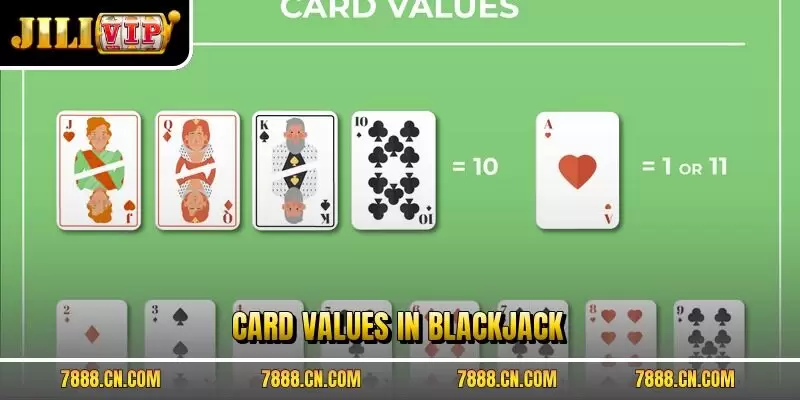
Card values in blackjack form the absolute core of the game, dictating every strategic decision, from when to hit to when to stand, and are essential for mastering basic strategy. JILIVIP offers a wide array of engaging blackjack tables where precise calculation of card values is mandatory for success.
Information about card values in blackjack basics
Information about card values in blackjack basics
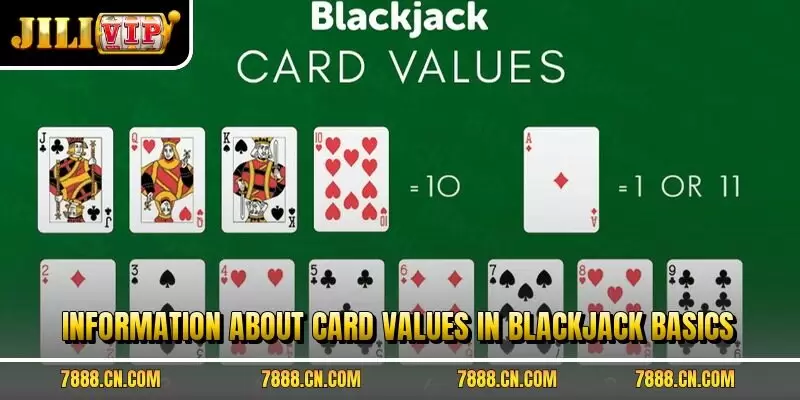
Blackjack card values simplify the 52-card deck into three categories, enabling players to quickly gauge hand strength and aim for a total of 21 without busting. This clear mathematical structure forms the foundation for all advanced strategies, including card counting and optimal betting decisions.
The Ace’s dual value as 1 or 11 creates soft hands, providing flexibility to avoid busting and adapt strategy mid-game. Understanding the difference between soft and hard hands is essential for making the most effective plays and maximizing long-term success in blackjack.
Analyzing the true card values in blackjack hands
Analyzing the true card values in blackjack hands
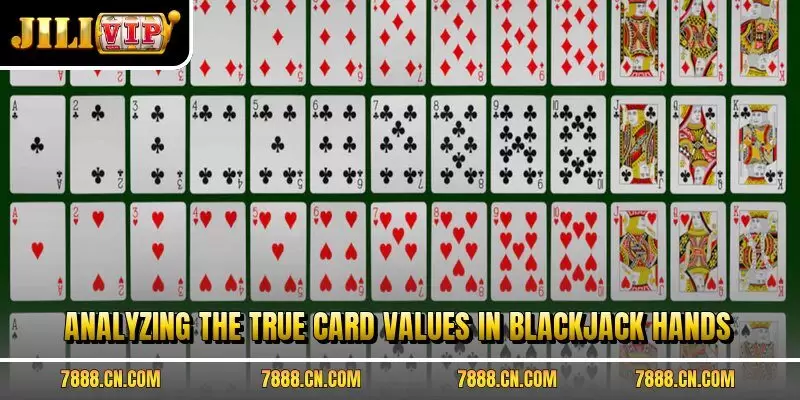
Successfully applying knowledge of card values in blackjack requires a detailed breakdown of each card’s fixed or variable numerical contribution and understanding how to calculate total hand strength correctly.
Fixed numerical values (2 through 9)
Cards ranked 2 through 9 are the simplest to calculate, as they always carry their face value, regardless of suit.
- Exact Value: The 2 counts as 2, the 5 counts as 5, the 9 counts as 9, and so forth.
- Calculation: When calculating a hand containing only these cards (e.g., 7 + 9), the total is fixed and straightforward (16). These hands are known as hard hands if they are above 11, and they carry a high risk of busting if a high card is drawn next.
The ten-value group (10, j, q, k)
All face cards (Jack, Queen, King) and the 10-spot card are grouped into a single, high-value category, significantly increasing the probability of a hand totaling 20 or 21.
- Ten Count: The 10, Jack, Queen, and King all carry a numerical value of 10.
- Impact: Since there are 16 cards (10s and face cards) in the deck valued at 10, this group accounts for approximately 30.7% of the cards. This high concentration of 10-value cards is critical for calculating basic strategy, as the dealer often has a 10 in the hole, and players are highly likely to draw a 10 when hitting on lower totals.
The variable value (the ace)
The Ace is the most powerful and strategic card in card values in blackjack due to its flexible valuation.
- Dual Value: The Ace can be counted as either 1 or 11, whichever benefits the player more without exceeding 21.
- Soft Hands: A hand containing an Ace counted as 11 is a soft hand (e.g., Ace-6 totals 17, but is soft 17). The player can safely hit this hand because if a 10-value card is drawn, the Ace automatically reverts to a value of 1, resulting in a non-busted hand (Ace-6-10 = 17).
- Hard Hands: If the Ace must be counted as 1 to avoid busting, the hand is treated as a hard total.
Knowing the exact ranking and the subtle differences in hand strength is vital for accurate decision-making in high-pressure situations at the JILIVIP tables.
Blackjack and the push rule
- Blackjack: The absolute card values in blackjack total of 21 is achieved with any 10-value card and an Ace. This results in a Blackjack and typically pays 3:2, unless the dealer also has Blackjack, in which case it is a Push (tie).
- Push Rule: A Push occurs when the player’s and dealer’s final totals are the same (e.g., both hit 19). The bet remains a draw for the participant.
| Card Rank | Card Value | Strategic Implication | Common Hand Status |
| 2-9 | Face Value | Simple counting; forms hard totals easily. | Hard (If total ≥12). |
| 10, J, Q, K | 10 | High probability of draw; forms Blackjack with Ace. | Hard. |
| Ace | 1 or 11 | Variable value; creates soft totals. | Soft (If counted as 11) |
These specific card values dictate the entirety of the strategic framework in every round of play.
Unlock high-yield tactics using sharp card values in blackjack

Unlock high-yield tactics using sharp card values in blackjack
Discover how understanding card values in blackjack can unlock high-yield tactics. Mastering this knowledge helps you make smarter plays and boost your winning potential.
Mastering soft hand strategy (ace is 11)
The tactical imperative is to always play a soft hand differently from a hard hand, taking advantage of the Ace’s ability to prevent a bust. A soft hand cannot bust on the next hit, which provides a strategic safety net.
Basic strategy often calls for hitting soft hands where a hard total would normally stand, such as Soft 17 or Soft 18 against a low dealer card. This approach allows you to improve a decent hand into a stronger one with minimal risk.
The defensive approach to hard 12 through 16
When your total hand value falls between Hard 12 and Hard 16, you are in the Danger Zone because the next card (the 10-value card) will cause you to bust. The tactical advice is to stand on these totals only when the dealer’s face-up card is weak (2 through 6).
This defensive move aims to avoid busting, relying instead on the high probability that the dealer, who must hit until 17, will bust themselves with the abundance of 10-value cards in the deck.
Aggressive play against weak dealer cards
When the dealer shows a 4, 5, or 6, their probability of busting is at its highest (due to the required hit on 12-16). The tactical move is to be aggressive by doubling down on any Hard 9, 10, or 11 total when the dealer shows these weak cards.
This leverages your advantage when the dealer is vulnerable, committing more money only when the mathematical edge is strongly in your favor. This is a critical basic strategy play using the known distribution of card values in blackjack.
Strategic splitting of aces and eights
Always remember the golden rule of splitting: always split Aces and always split Eights. Splitting Aces gives you two chances at Blackjack, starting from a strong total of 11.
Splitting Eights, which total 16, transforms one of the worst hands into two starting hands of 8, greatly improving your chances against any dealer upcard. Never deviate from this essential basic strategy based on the initial card values in blackjack.
Conclusion
The precise knowledge of card values in blackjack is not just about counting; it is the cornerstone of all profitable basic strategy, guiding every hit, stand, and double decision at JILIVIP. By mastering the Ace’s flexibility and playing defensively against the dealer’s weakest cards, you eliminate costly mistakes.
 Midas Touch Clever Tricks To Enjoy Golden Gameplay
  Lazy Rich – Master JILIVIP With These Simple Cheats
  King Of Fighting – Master The JILIVIP Combo Tricks
  Full Moon Lanterns – How To Find JILIVIP Lucky Hits
  Dragon Pearl Legendary Fortune Awaits Every Single Spin
  Searing Dragon Palace Adventure – Drain The JILIVIP Sea Vault