
 JILIVIP
 Bingo
Bingo Casino
 Fishing
 Sabong
 Slot Games
 Sports
 Promotion
 Lottery
 News
News
Poker cards ranking determines the winner of every single pot in Texas Hold’em and Omaha, making its immediate recognition absolutely critical for both beginners and experienced players. JILIVIP provides a secure platform for all popular poker variants where knowledge of the poker cards is fundamental for success.
Get started with the basic poker cards ranking
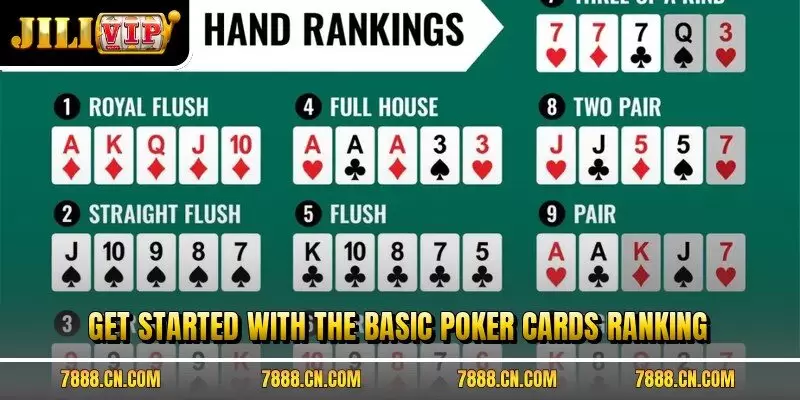
Get started with the basic poker cards ranking
poker cards ranking are based on the probability of drawing specific five-card combinations, with rarer hands being stronger. This universal hierarchy applies across popular variants like Texas Hold’em and Omaha, helping players calculate odds and make informed bets.
Only the best five-card hand counts, combining hole and community cards. Kickers play a key role in breaking ties, ensuring accurate determination of winners even with similar hand types.
Understanding the essential poker cards ranking rules

Understanding the essential poker cards ranking rules
Successfully applying poker cards ranking knowledge requires a detailed, hierarchical breakdown of each hand, from the rarest and strongest to the most common and weakest, along with their statistical probabilities.
The elite hand rankings (royal flush down to four of a kind)
These hands represent the absolute pinnacle of the poker cards ranking and are extremely rare, making them immediate pot-winners in almost any scenario.
- Royal Flush: A 10, J, Q, K, A of the same suit. This is the rarest hand, statistically occurring once every 649,739 hands. Probability: 0.000154%. It is unbeatable.
- Straight Flush: Five cards in sequence, all of the same suit (e.g., Hearts cards 5, 6, 7, 8, 9). Extremely rare, second only to the Royal Flush.
- Four of a Kind: Four cards of the same rank (e.g., four Queens). This hand is highly dominant; its strength depends on the rank of the four cards and the kicker.
The intermediate hand rankings (full house down to three of a kind)
These hands are strong, frequently pot-winning hands, but they carry a real risk of being beaten by the Elite hands or a stronger version of the same hand.
- Full House: Three cards of one rank and two cards of another rank (e.g., three Kings and two Fours). The ranking is determined by the three cards first (e.g., KKK44 beats QQQAA). This is a mandatory betting hand, but caution is needed if the board is paired, allowing for many possible Full Houses.
- Flush: Five cards from the same suit, not in sequence (e.g., A, K, 7, 4, 2 of Spades). The value of the hand is established by the topmost card. A flush is extremely powerful, but vulnerable to a Full House or higher.
- Straight: Five cards in sequence, but not all of the same suit (e.g., 8, 9, 10, J, Q from various suits). This hand is frequently seen and often wins mid-sized pots.
Knowing the exact ranking and the subtle differences in hand strength is vital for accurate decision-making in high-pressure situations.
The lower hand rankings (two pair down to high card)
These hands are the most common and represent the majority of winning and losing showdowns.
- Three of a Kind (Set/Trips): Three cards of the same rank. A Set (when you hold a pair and hit the third on the board) is often disguised and extremely powerful. Trips (when the pair is on the board) is more common and vulnerable.
- Two Pair: Two cards of one rank and two cards of a second rank. The ranking is determined by the highest pair, then the second pair, and finally the kicker. This is the hand most often involved in split pots or bad beats.
- One Pair: A duo of cards sharing an identical value. The rank is determined by the pair, followed by the highest three kickers. High pairs (AA, KK, QQ) are premium pre-flop hands.
- High Card: Five cards that fail to form any of the combinations listed above. The rank is determined by the highest single card. This hand almost never wins unless opponents fold or the board is completely blank.
| Hand Ranking | Example Hand | Description | Probability (Approx.) |
| Royal Flush | A K Q J 10 (Same Suit) | Unbeatable sequence, same suit. | 0.000154% |
| Four of a Kind | A A A A 7 | Four cards of the same rank. | 0.024% |
| Full House | K K K A A | Three cards of one rank, two of another. | 0.14% |
| Flush | A Q 9 5 2 (Same Suit) | Five cards of the same suit. | 0.20% |
| Straight | 7 8 9 T J (Mixed Suits) | Five cards in sequence. | 0.39% |
| Two Pair | Q Q 8 8 A | Two pairs of matching ranks. | 4.75% |
| One Pair
|
A A K Q J
|
Two cards of the same rank. | 42.25% |
These hand rankings dictate the entirety of the strategic framework in every round of poker cards ranking play.
Applying smart techniques based on poker cards ranking data

Applying smart techniques based on poker cards ranking data
Mastering poker requires applying smart techniques based on card rankings. Using this knowledge helps you make better decisions and maximize your winning potential.
Calculating implied odds based on outs
The tactical imperative is to use your knowledge of the poker cards ranking to calculate your “outs” (cards that will improve your hand to a winning hand). If you hold a Flush Draw (9 outs), you have approximately a 36% chance of hitting it by the River.
The strategic move is to compare these implied odds to the pot odds offered. Only call a bet if the potential payoff (the size of the pot plus projected future bets) justifies the risk, turning marginal draws into positive EV calls.
The critical role of the kicker card
The kicker card is disproportionately important in the lower-ranking hands (One Pair and Two Pair). The tactical advice is to severely undervalue hands where your pair is strong but your kicker is weak (e.g., Ace-Two or King-Seven).
A strong pair with a weak kicker often loses to a slightly lower pair with a higher kicker or splits the pot. Never bet aggressively with a weak kicker unless you are confident the opponent only holds a high card.
Recognizing board texture and opponent range
Successful play relies on determining what poker cards ranking your opponent is likely to hold based on the board texture. If the board shows three cards of the same suit, the tactical advice is to assume your opponent may have a Flush, drastically diminishing the value of your Two Pair.
This constant re-evaluation of your hand’s strength relative to the possible opponent range is crucial. A simple Straight on a Dry board (unconnected, unsuited cards) is far stronger than the same Straight on a Coordinated board (suited, connected cards).
Conclusion
The poker cards ranking is the bedrock of strategic poker, defining value and risk in every decision you make at the JILIVIP tables. By meticulously understanding the hand hierarchy, valuing the importance of the kicker, and accurately calculating your outs, you gain a measurable advantage.
 Midas Touch Clever Tricks To Enjoy Golden Gameplay
  Lazy Rich – Master JILIVIP With These Simple Cheats
  King Of Fighting – Master The JILIVIP Combo Tricks
  Full Moon Lanterns – How To Find JILIVIP Lucky Hits
  Dragon Pearl Legendary Fortune Awaits Every Single Spin
  Searing Dragon Palace Adventure – Drain The JILIVIP Sea Vault